
Projects
CAROSA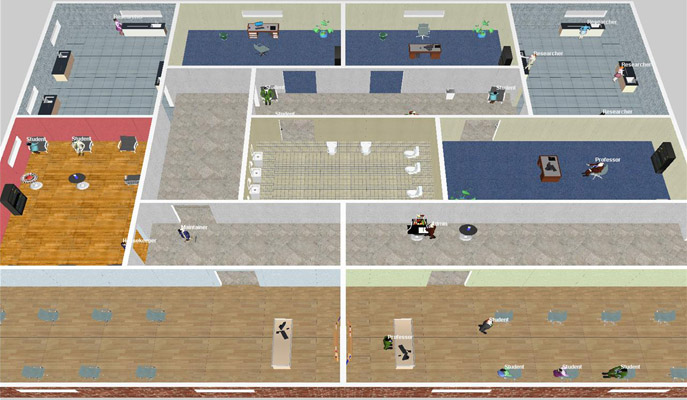

(Crowds with Aleatoric, Reactive, Opportunistic, and Scheduled Actions)
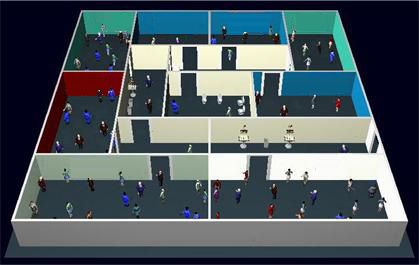
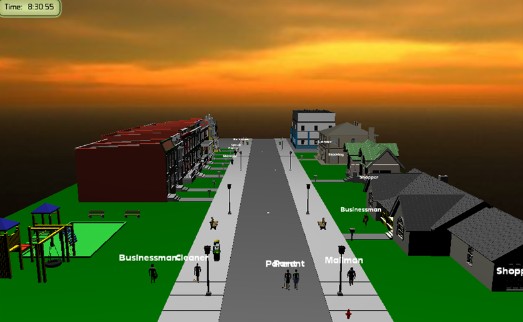
Most crowd simulation research either focuses on navigating characters through an environment while avoiding collisions or on simulating very large crowds. This work focuses on creating populations that inhabit a space as opposed to passing through it. Characters exhibit behaviors that are typical for their setting. We term these populations functional crowds. A key element of this work is ensuring that the simulations are easy to create and modify. Roles and groups help specify behaviors, a parameterized representation adds the semantics of actions and objects, and four types of actions (i.e. scheduled, reactive, opportunistic, and aleatoric) ensure rich, emergent behaviors. To do this, we:- Specify the characteristics (e.g. roles, goals, constraints) of individuals or groups including their behaviors and how they might differ from other individuals.
- Establish the temporal (e.g. daily) activities of such individuals or groups according to their occupations or roles.
- Access a library of parameterized animated behaviors that can be selected contextually, varied statistically, applied to agents, and executed in a simulation environment.
- Give the agents enough attention and perception to react to the environment and people around them.
- Link the framework to Commercial- Off-The-Self (COTS) software used for scheduling, enabling non-programmers to create simulations.
Publications
.jpg) |
Li, W. and Allbeck, J.M. The Virtual Apprentice. In Proceedings of Intelligent Virtual Agents 2012. To Appear. |
 |
Li, W., Di, Z., and Allbeck, J.M. Crowd Distribution and Location Preference. In Journal of Computer Animation and Virtual Worlds. Vol. 23 Iss. 3-4, pp. 343-351, May 2012. |
 |
Li, W. and Allbeck, J.M. Populations with Purpose. In Proceedings of Motion in Games. Springer, pages 133-144, 2011. |
| Allbeck, J.M. and Badler, N.I. Simulating Human Activities for Synthetic Inputs to Sensor Systems. In Distributed Video Sensor Networks. B. Bhanu, C.V. Ravishankar, A.K. Roy-Chowdhury, H. Aghajan, and D.Terzopoulos (Eds). Springer. 2011, pages 193-206. | |
| Durupinar, F., Pelechano, N., Allbeck, J., Gudukbay, U., and Badler, N. The Impact of the OCEAN Personality Model on the Perception of Crowds. IEEE Computer Graphics and Applications. vol. 31, no. 3, pp. 22-31, May/June, 2011. | |
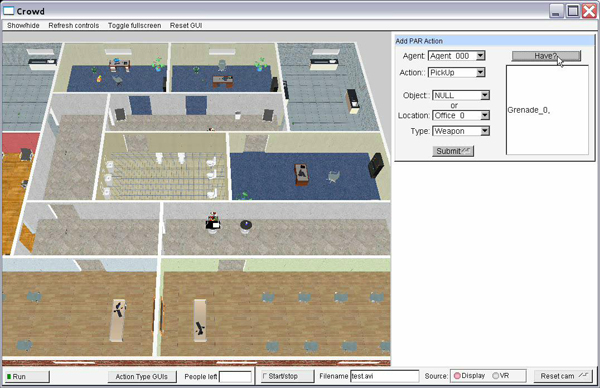 |
Allbeck, J.M. CAROSA: A Tool for Authoring NPCs. In Proceedings of Motion in Games. Springer, 2010, pages 182-193. |
|
Allbeck, J.M., Functional Crowds. In Workshop on Crowd Simulation co-located with the 23rd Annual Conference on Computer Animation and Social Agents. Saint Malo, France, 2010. |
| Allbeck, J.M. Creating 3D Animated Human Behaviors for Virtual Worlds. Department of Computer and Information Science, University of Pennsylvania, Philadelphia, PA, 2009. | |
| Pelechano, N., Allbeck, J. and Badler, N. Virtual Crowds: Methods, Simulation, and Control. Morgan and Claypool Publishers, San Rafael, CA, 2008. |
Sponsors
Partial support for this effort is gratefully acknowledged from the U.S. Army SUBTLE MURI W911NF-07-1-0216 and George Mason University.